

Dual Energy (An Application of X-ray Wavelengths)
It is widely known that X-rays can pass through matter, which is used to obtain transmission images. All the information from the X-rays passing through the object overlaps into a single image, expressed as shades of gray. Shape is the primary information this provides.
Food Foreign-Object Inspection (Cereal and Aluminum Pieces)
Food manufacturers take a variety of measures and carry out inspections to prevent foreign-object contamination. One of these is non-destructive inspection using X-rays. In this example, we place aluminum pieces (0.5mm and 1.0mm thick) in cereal and test whether the aluminum pieces can be identified as foreign objects.

You might think they would be easy to identify in an X-ray transmission image. Here are the actual results captured with an FPD (TFT).

The cereal and the aluminum plates overlap, making the aluminum pieces difficult to distinguish even when we know their shape. In practice, the shape of a foreign object is not known in advance, which makes identification even harder. Shape information expressed only as shades of gray is not enough to identify them.
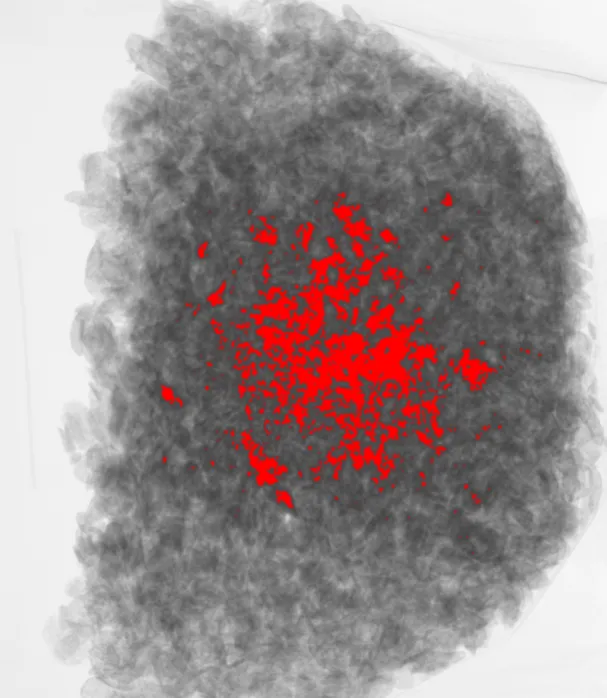
Changing the tube voltage of an X-ray source changes the wavelengths (energy) it emits. The method of using two different wavelengths is called dual energy. Below, images taken at two different wavelengths have been processed to highlight the aluminum pieces. Compared with a conventional transmission image, the effect of dual energy is obvious at a glance.
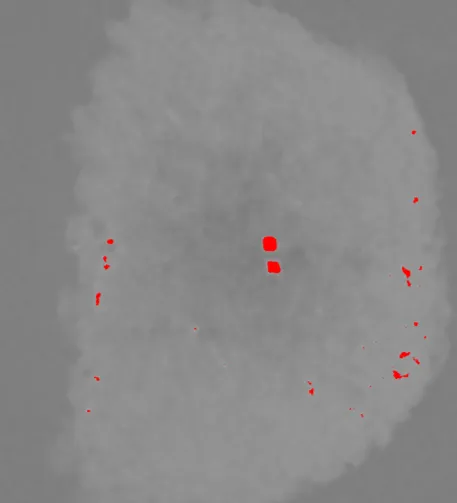
Next, here are the results of the same processing performed with a CdTe line sensor (integrating type).
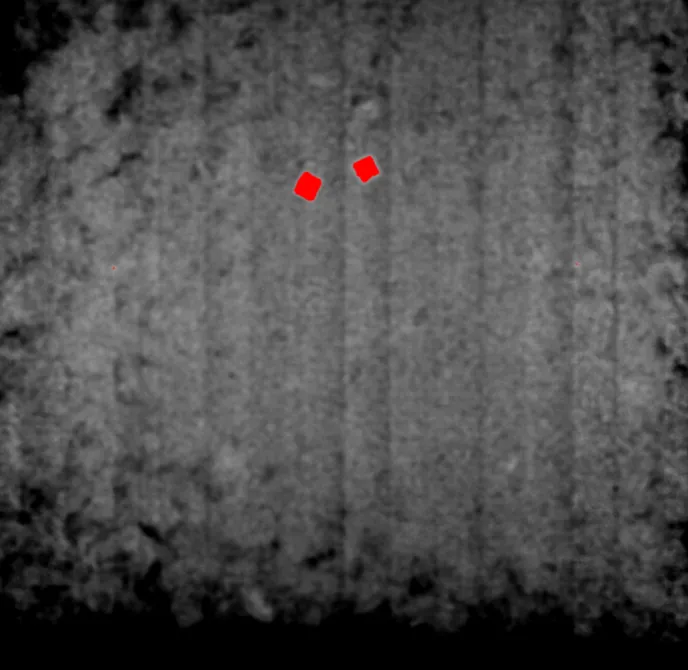
Here too, both aluminum pieces can be identified.
These imaging examples with two X-ray cameras confirm the effectiveness of dual energy. In practice, however, two exposures are required: one at low energy and one at high energy. In food inspection, capturing two images while the contents remain completely still is extremely difficult. What is needed, therefore, is the ability to separate low and high energy in a single exposure. This can be achieved with photon counting energy discrimination. The images below are an actual example from our CdTeFPD (3x3). Because the sensor is small, at 3cm x 3cm, metal markers were placed to identify position. Low-energy and high-energy images of the aluminum pieces and metal markers are obtained simultaneously in a single exposure. Processing these two images makes it possible to identify the aluminum pieces.
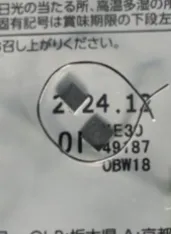
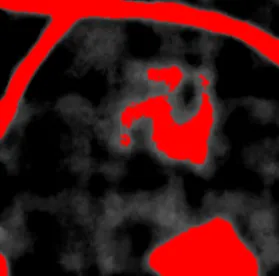
In this way, dual energy may make identification possible even in cases where shape alone has made it difficult.