

Sensor Module
The smallest building block of ANSeeN’s PCFPD is the sensor module, which has a stacked (hybrid) structure consisting of a compound semiconductor photodiode and a readout circuit. The role of each element is as follows.
-
Compound semiconductor photodiode: A pixel array sensor that converts X-rays into electric charge.
-
Readout circuit: A dedicated integrated circuit (ASIC) manufactured in a CMOS process that processes the charge signals from the compound semiconductor photodiode and converts them into digital signals.
By electrically bonding the pixels of the compound semiconductor to those of the ASIC, every pixel of the compound semiconductor pixel array is connected to its own photon counting circuit. As a result, each fine 0.1 mm square pixel functions as an independent photon counting sensor. ANSeeN’s sensor module has a 96x96 pixel configuration, so it operates as an imager with approximately 10,000 pixels in total.
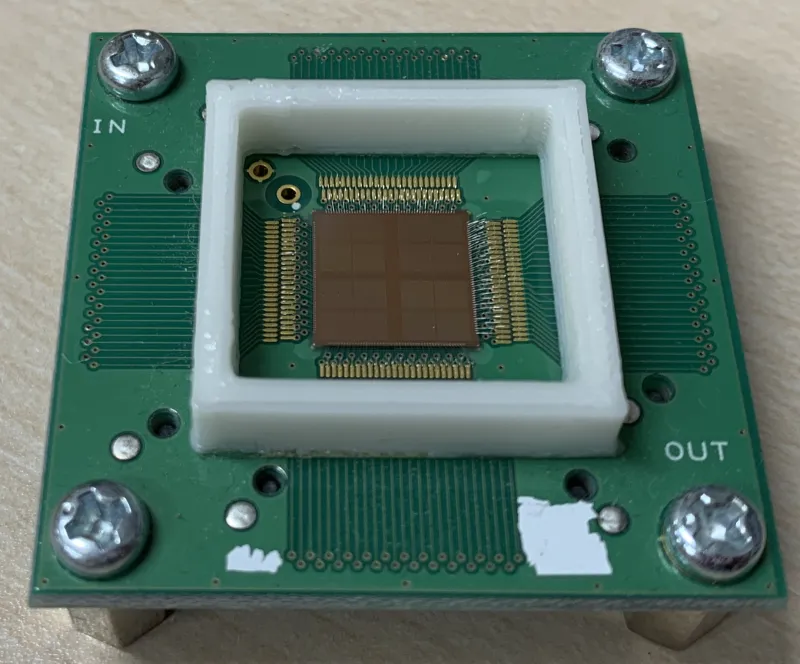 Sensor module
Module Specifications
Module Specifications
| Specification | Unit | |
|---|---|---|
| Number of pixels | 96x96 | pixel |
| Pixel size | 0.1x0.1 | mm |
| Number of pins | 200 | pin |
| Frame rate | 800 | fps |
Sensor Unit
ANSeeN’s PCFPD uses a tiled mounting approach in which sensor modules are arranged vertically and horizontally to operate as a single large panel. This approach offers numerous advantages in terms of both product performance and manufacturing, as listed below.
Product Advantages
-
The same module supports everything from small to large areas
-
Line sensors (selectable width)
-
Irregularly shaped sensors (line + FPD, arc gantry)
Manufacturing Advantages
-
Only one type of module needs to be manufactured
-
A size that is easy to handle with manufacturing equipment
Sensor Unit with 12x12 Modules
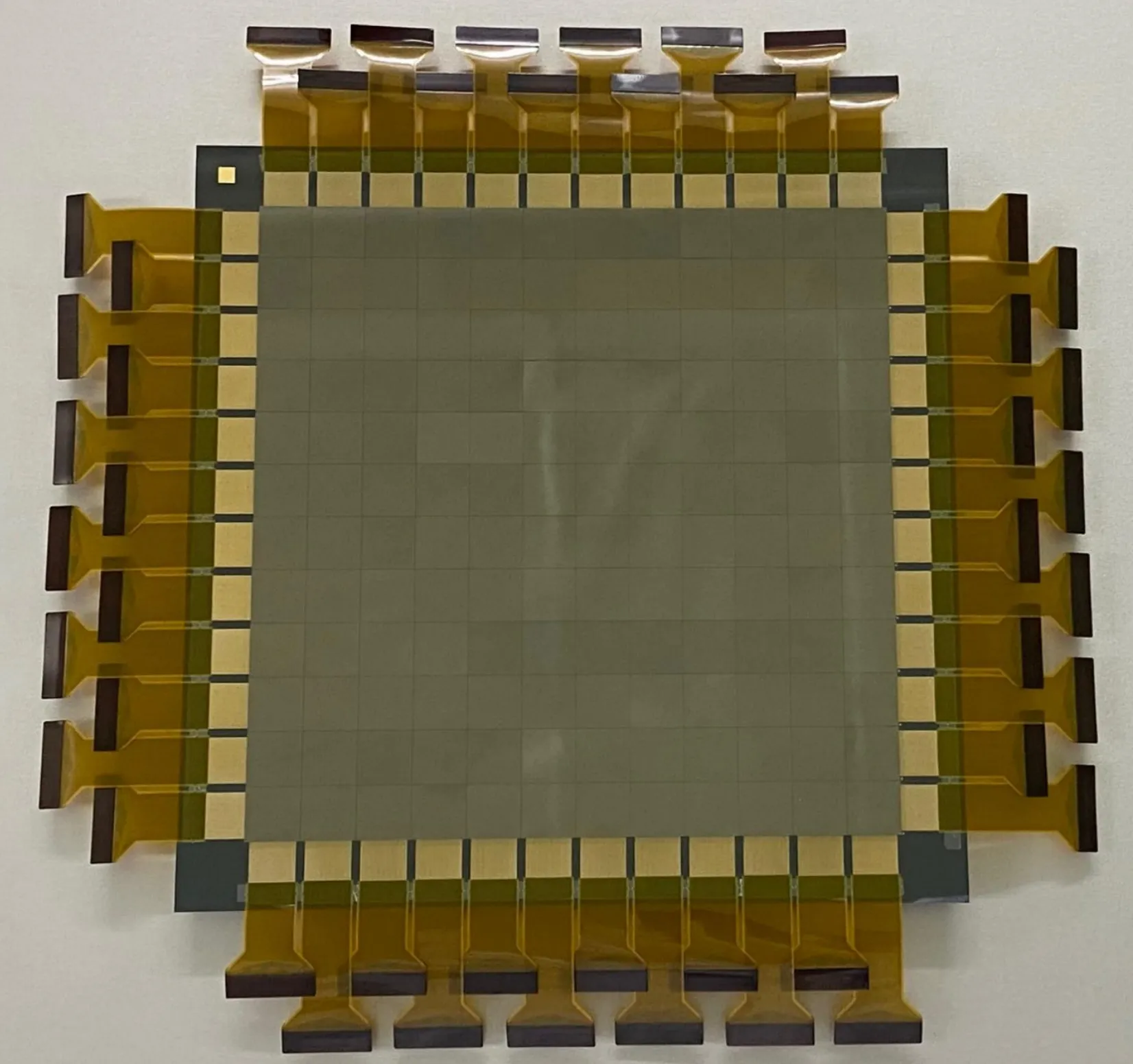 Sensor unit
FPD System
Mounting the sensor unit on a control circuit allows it to function as an FPD system capable of image acquisition and more. The total number of wires (pins), including power, control signals and output signals, is determined by the number of tiled modules and is calculated with the formula below. For example, with 12 modules vertically and 12 modules horizontally, the total is 2400.
Total wires = 2 x (50 x number of vertical modules + 50 x number of horizontal modules)
ANSeeN also develops the control circuitry, which handles this power and signal input/output and delivers the signals through interfaces such as GbE and Camera Link. Real-time data acquisition through continuous imaging is also supported, enabling video and CT imaging.
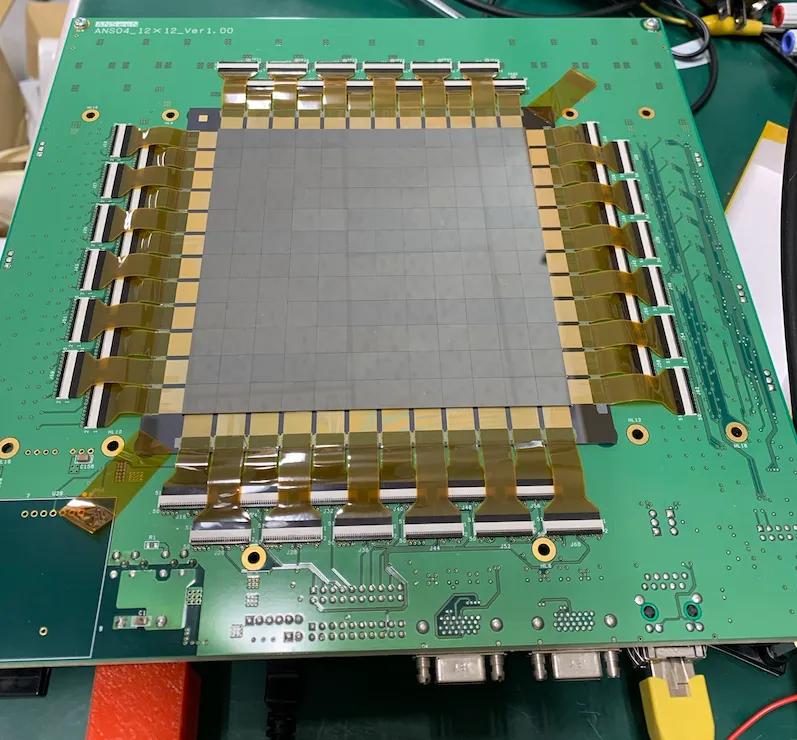 Sensor system
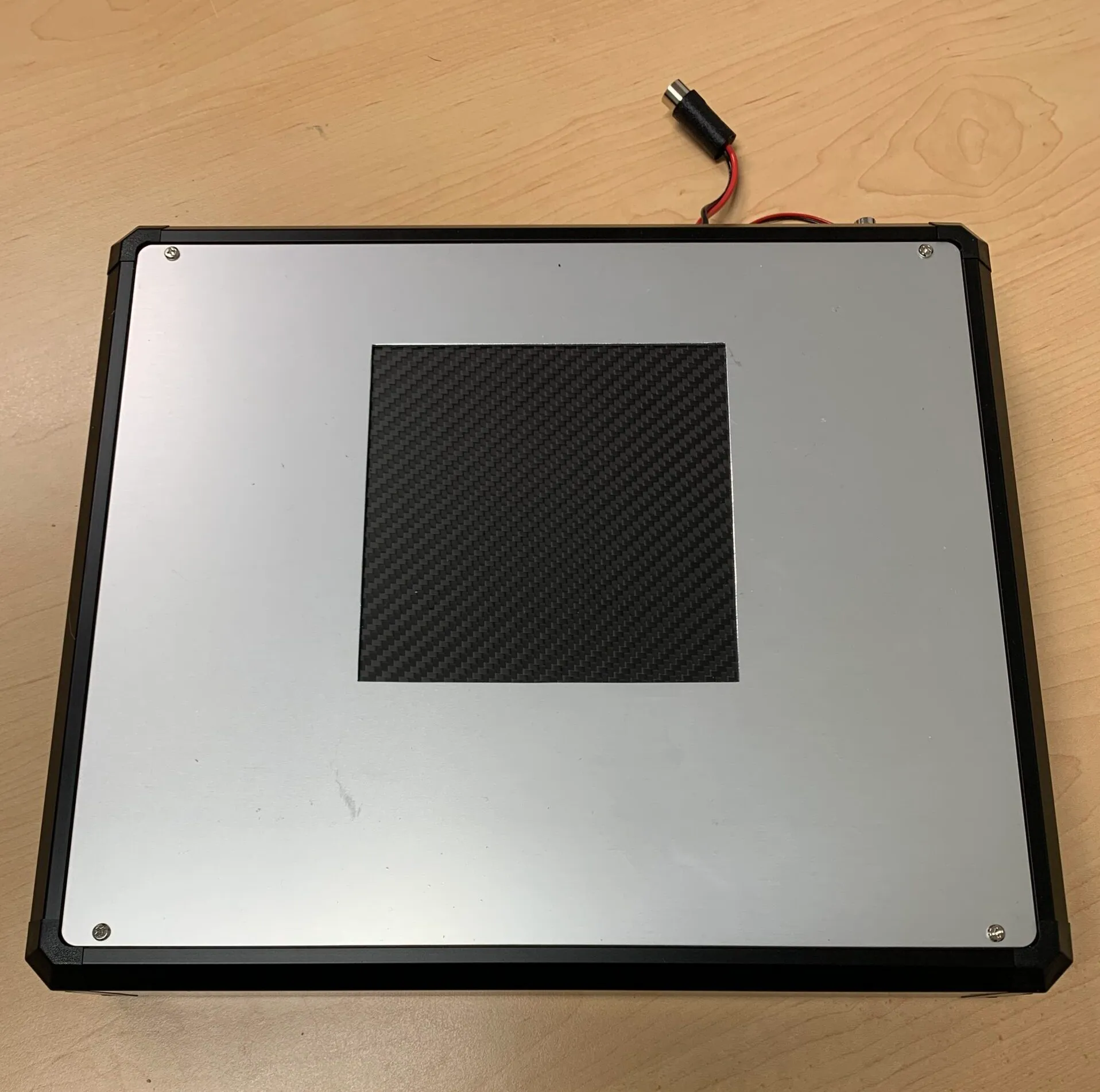 CdTe FPD prototype